


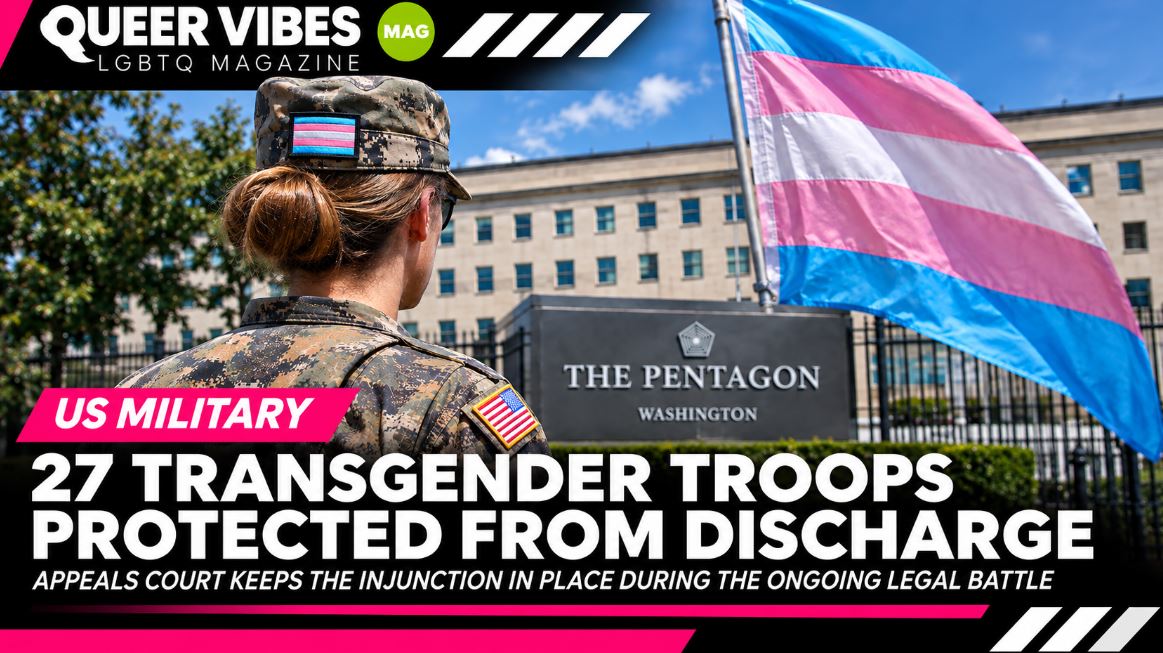
A federal appeals court has cleared the way for 27 transgender US military personnel to remain protected from discharge under the Trump administration’s transgender military policy. The November 17, 2026, decision allows an earlier injunction to take effect immediately, preventing the Pentagon from removing the service members involved in the lawsuit while their legal challenge continues. However, the ruling does not extend to people seeking to enlist or permanently overturn the administration’s restrictions.
The US Court of Appeals for the District of Columbia Circuit rejected the government’s request to keep its June 1 ruling on hold while the administration seeks Supreme Court review.
The decision marks another development in Talbott v. USA, a lawsuit challenging restrictions introduced by President Donald Trump and Defense Secretary Pete Hegseth in 2025.
The three-judge panel rejected the administration’s request by a 2–1 vote, ordering its previous ruling to take effect without further delay.
For the 27 transgender service members involved, the immediate consequence is protection against involuntary discharge under the contested policy while the litigation proceeds.
What the November 17 ruling changes for transgender troops
The service members covered by the order have collectively completed more than 130 years of military service and received over 80 commendations, according to their legal representatives.
Their lawyers say the government has acknowledged that the plaintiffs served honorably and satisfied the military’s professional requirements.
Despite those records, several had faced discharge proceedings under the Pentagon’s revised eligibility rules. Others had been placed on administrative leave.
Until November 17, the appeals court’s June decision had not taken effect because its implementation remained suspended while the government pursued further legal options.
The administration sought to extend that suspension until the Supreme Court decided whether to review the case.
The appeals court refused.
In his accompanying opinion, Judge Robert Wilkins found that the government had not adequately demonstrated that allowing the affected personnel to remain in military service would cause irreparable harm.
The administration had argued that enforcing the court’s earlier decision could interfere with military policy and national security responsibilities.
Wilkins, however, found that those concerns lacked a sufficiently specific explanation of the harm expected from retaining the plaintiffs.
Judge Judith Rogers joined the decision to reject the government’s request, while Judge Justin Walker would have granted the suspension.
The order does not automatically resolve every employment or administrative issue affecting the plaintiffs, but it prevents their removal under the challenged restrictions while the injunction remains effective.
How the dispute over transgender military service began
The lawsuit followed an executive order signed by President Trump on January 27, 2025, directing the Pentagon to revise its policies concerning transgender military personnel.
Defense Secretary Pete Hegseth subsequently introduced rules restricting transgender military service, including provisions that presumptively disqualify individuals with a history of gender dysphoria.
The policy also addresses individuals who have undergone or attempted gender transition.
The restrictions have also affected access to healthcare. In May 2025, the Pentagon ordered a suspension of certain gender-affirming treatments for transgender service members, adding another dimension to the controversy surrounding the administration’s military policy.
The administration has defended the restrictions by invoking military readiness, professional standards and operational effectiveness.
LGBTQ+ civil rights organisations have challenged those justifications, arguing that the measures discriminate against transgender people regardless of their individual ability to serve.
The legal battle began almost immediately.
In March 2025, US District Judge Ana Reyes issued a preliminary injunction against the policy, concluding that the plaintiffs were likely to succeed on their constitutional claims.
The order was subsequently suspended during the government’s appeal.
On June 1, 2026, the D.C. Circuit upheld part of the injunction, finding that the policy likely violated constitutional equal protection guarantees as applied in the case.
The appeals court determined that the restrictions went beyond medical eligibility standards and targeted transgender identity.
However, its decision was limited in scope.
While the judges maintained protection for plaintiffs already serving in the military, they removed the injunction’s protection for those seeking to enlist.
The government then requested a further suspension while pursuing Supreme Court intervention.
That request was rejected on November 17.
Why the injunction does not protect all transgender service members
Although the ruling provides an important legal safeguard for the plaintiffs, it does not amount to a nationwide suspension of the Pentagon’s transgender military policy.
The current protection applies to the 27 serving personnel covered by the injunction.
It does not extend the same protection to prospective recruits.
This distinction matters because the Supreme Court previously allowed the administration to enforce its transgender military restrictions while litigation continued in a separate case, United States v. Shilling.
In November’s decision, Judge Wilkins distinguished the two proceedings.
The injunction examined in Shilling had been nationwide in scope, while the protection at issue in Talbott concerns a defined group of individuals already serving.
The narrower nature of the injunction was therefore relevant to the court’s assessment of the government’s request.
Although a federal district court has separately certified a broader class in the Talbott litigation, the November 17 order does not itself extend the immediate discharge protection to every transgender member of the armed forces.
For thousands of transgender personnel outside the protected group, the wider legal uncertainty remains.
What happens next at the Supreme Court?
The Trump administration has already asked the US Supreme Court to examine the June 2026 appeals court decision.
The petition, filed on August 27, is registered as case No. 26-272, United States v. Talbott.
According to the Supreme Court’s official docket, the petition was distributed on November 17 for consideration at the justices’ conference scheduled for December 4, 2026.
That procedural step does not mean the Court has agreed to hear the case.
The justices may decide whether to take up the dispute, but no decision accepting review has been announced as of November 18.
Meanwhile, the underlying lawsuit continues in federal district court, where a trial is scheduled to begin in January 2027.
The outcome could have wider implications for the administration’s ability to restrict transgender military service.
For now, the situation remains divided: the Pentagon’s broader policy continues to face legal challenges, while the 27 plaintiffs have secured immediate protection against discharge.
The November 17 decision offers temporary legal protection rather than a final resolution. The constitutional dispute over transgender military service remains open, with the Supreme Court’s next steps still uncertain.
Sources:




 English
 Español
Leave a Reply