


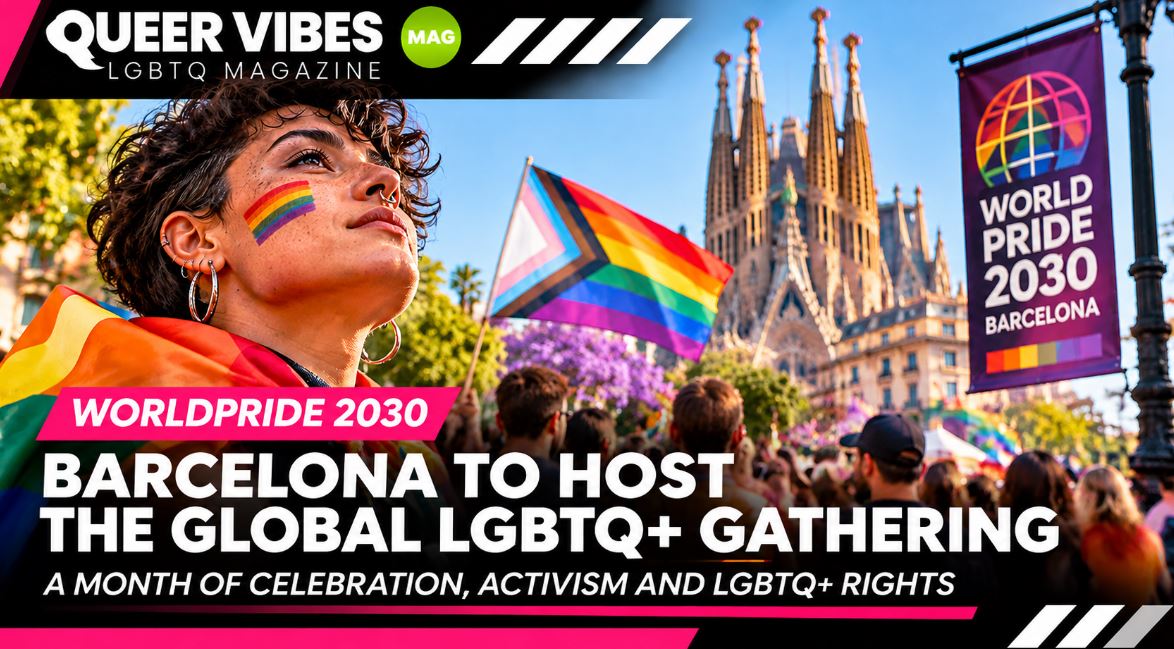
Barcelona will host WorldPride 2030 after securing a decisive victory over Bangkok in an international vote. The Spanish city is planning a month-long programme of Pride marches, cultural events and human rights discussions, running from June 28 to July 28, 2030. But the ambition extends beyond bringing another major LGBTQ+ festival to Europe: organisers want Barcelona to become a meeting point for activists confronting discrimination and threats to equality around the world.
The decision was announced on November 12, 2026, following InterPride’s annual conference in Phuket, Thailand.
Barcelona received 413 votes, representing 84% of the votes cast for the two competing cities, compared with 78 for Bangkok. Eight members abstained.
The result gives Spain the opportunity to host WorldPride for a second time, following Madrid’s edition in 2017.
Pride Barcelona, which led the successful bid, spent more than two years building international partnerships and securing support from community organisations and public institutions.
The city has initially been awarded a provisional licence under InterPride’s selection process. Further organisational requirements must be completed before the hosting arrangements are finalised.
Why Barcelona’s WorldPride 2030 bid stood out
WorldPride is not simply a larger version of an annual Pride parade.
Licensed by InterPride, the international association of Pride organisers, it is designed to connect LGBTQ+ movements across national borders, increase visibility and provide opportunities for collective advocacy.
Barcelona positioned those objectives at the heart of its proposal.
More than 40 LGBTQIA+ organisations contributed to the bid, which also received institutional support from Barcelona City Council, the Catalan government and Spain’s Ministry of Equality.
Rather than presenting the city exclusively as a tourist destination, organisers emphasised its history of activism and its potential to support communities facing political hostility.
Their campaign adopted the slogan “Let’s Think. Let’s Answer. Let’s Change.”
The message reflects three connected ambitions: examining the challenges facing LGBTQ+ people, developing coordinated responses and turning international discussions into lasting action.
Barcelona Mayor Jaume Collboni has also highlighted the importance of supporting LGBTQ+ communities in countries where holding public Pride celebrations remains difficult or dangerous.
For the organisers, the test will be whether a global festival can produce meaningful cooperation between community groups long after visitors have returned home.
WorldPride Barcelona 2030: Dates, marches and planned events
The proposed celebration will take place between June 28 and July 28, 2030, making it one of the most extensive Pride programmes Barcelona has undertaken.
Instead of concentrating activities around a single parade, the bid outlines several major gatherings with distinct purposes.
Three marches are planned, combining local LGBTQ+ history with regional and international mobilisation.
One proposed demonstration would take place along La Rambla, recalling the city’s landmark 1977 protest. A Mediterranean march is envisaged near the waterfront, while the main WorldPride parade would bring participants together in central Barcelona.
The bid also includes concerts, exhibitions, cultural programmes and activities designed to involve different parts of the city.
A particularly important component is the proposed international human rights conference.
Scheduled in the bid for July 16–19, the conference would bring together activists, civil society organisations and specialists working on LGBTQ+ equality.
Discussions are expected to address the challenges facing LGBTQ+ communities in different political and social environments, including discrimination, restrictions on fundamental freedoms and the need for international cooperation.
The preliminary programme identifies July 20 as the date of the main WorldPride march.
These are proposed dates from the organising bid, rather than a fully confirmed public programme. Detailed schedules, venues and participation arrangements may change before 2030.
From the first protests to today’s LGBTQ+ movement
Barcelona’s selection carries particular significance because of its place in Spain’s LGBTQ+ history.
On June 26, 1977, thousands of demonstrators gathered on La Rambla to protest the repression of homosexuality.
The demonstration, organised by the Front d’Alliberament Gai de Catalunya (FAGC), is widely recognised as Spain’s first major public protest for gay rights.
It took place during the country’s transition to democracy following Francisco Franco’s death in 1975.
Despite the end of the dictatorship, laws inherited from the previous regime continued to criminalise or punish people because of their sexuality.
Police forcibly dispersed the Barcelona demonstration, but it became an important milestone in the development of Spain’s LGBTQ+ rights movement.
The FAGC subsequently obtained legal recognition in 1980.
When WorldPride arrives in 2030, the city will mark the fiftieth anniversary of that recognition.
Another anniversary will also shape the celebrations.
Spain legalised same-sex marriage in 2005, becoming one of the first countries to introduce marriage equality nationwide.
WorldPride 2030 will coincide with the twenty-fifth anniversary of that reform.
Together, these milestones offer an opportunity to examine how Spain moved from state repression to legal recognition of LGBTQ+ relationships, while acknowledging that discrimination and inequalities have not disappeared.
They also give the event a historical dimension that distinguishes Barcelona’s proposal from a conventional international festival.
What Barcelona’s victory means for the global Pride movement
Bangkok’s unsuccessful bid represented another potentially significant direction for WorldPride.
Thailand has experienced important changes in LGBTQ+ rights, including the introduction of marriage equality in 2025.
Hosting WorldPride in Bangkok would have brought the event to Southeast Asia for the first time, creating a major platform for activists across a region where legal protections and social attitudes vary considerably.
Bangkok Pride presented its candidacy under the theme “Until All of Us Are Free”, emphasising regional solidarity and the need to address inequalities beyond national borders.
Although the Thai capital did not secure the 2030 edition, its participation demonstrated growing international interest in hosting the event.
That geographical dimension is particularly important as WorldPride prepares for its next edition.
Cape Town, South Africa, is scheduled to host WorldPride in 2028, becoming the first African city to organise the event.
The selection is significant for LGBTQ+ organisations working across a continent where legal recognition, protections and restrictions differ sharply between countries.
Following Cape Town, Barcelona will bring the event back to Europe.
The growing competition to host WorldPride is also evident elsewhere. London has announced plans to pursue WorldPride 2032, linking its ambitions to the sixtieth anniversary of the city’s first Pride march.
For the international movement, the question is increasingly not only which city can organise the largest celebration, but which hosts can create meaningful opportunities for advocacy, inclusion and community development.
Can Barcelona turn a major Pride festival into a lasting legacy?
WorldPride 2030 could bring substantial international attention and economic activity to Barcelona.
Visitors are likely to contribute to the hospitality, transport, restaurant and cultural sectors, while the event could strengthen the city’s profile as an LGBTQ+-inclusive destination.
However, hosting such a large gathering will also present practical challenges.
Barcelona has already faced debates over overtourism, housing pressures and the effects of large visitor numbers on local neighbourhoods.
The scale of WorldPride will require careful planning around accessibility, transport, accommodation and public safety.
Community participation will be equally important.
For LGBTQ+ organisations based in Barcelona, the opportunity to collaborate with international networks could prove more valuable in the long term than a temporary increase in visitor numbers.
The proposed human rights conference and associated partnerships may help support projects that continue beyond the festival.
That ambition is central to Barcelona’s approach: using the visibility of a major global event to strengthen the organisations and networks working for LGBTQ+ rights.
There are still several years of planning ahead, and many programme details remain provisional.
Nevertheless, the 2030 edition already has a distinctive identity. It will connect the legacy of Barcelona’s 1977 demonstrations with contemporary struggles for equality, offering a platform for communities whose rights remain contested.
For Barcelona, the opportunity is to show that WorldPride can celebrate how far LGBTQ+ movements have come while helping shape what comes next.
Primary sources: InterPride — WorldPride and WorldPride Barcelona 2030 — Official Bid.


 English
 Español
Leave a Reply