


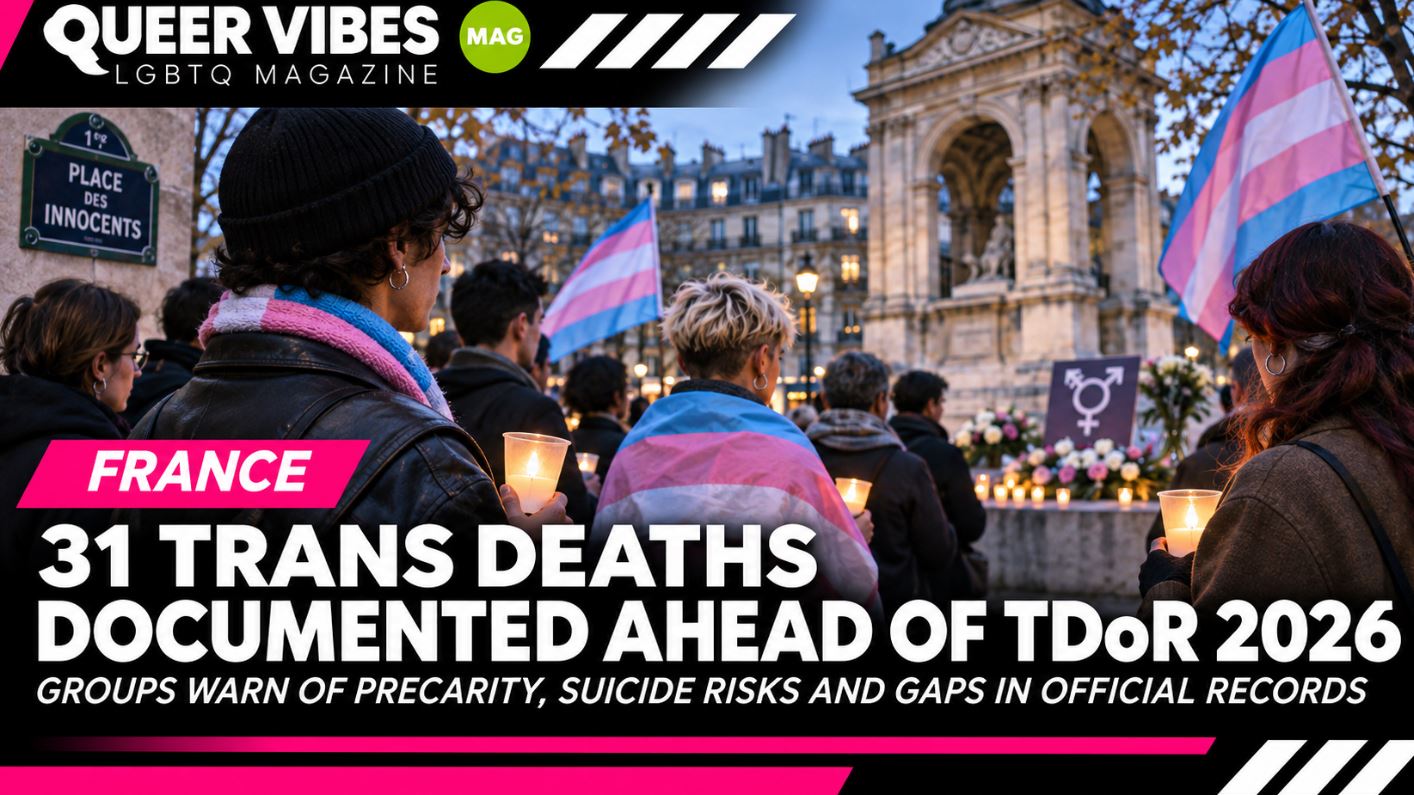
Five French transgender rights organisations have documented 31 deaths within their communities over the past year, ahead of Trans Day of Remembrance on November 20, 2026. The findings include suicides, homicides and other deaths, raising questions about how France records the circumstances in which transgender people die.
The figures were compiled by Acceptess-T, Collectif Insurrection Trans, Front Transfem, PASTT and OUTrans through information gathered from community networks.
Their findings are not an official national mortality statistic. They represent cases identified by the organisations, which say the absence of dedicated public monitoring makes it difficult to establish the full picture.
The release comes as memorial gatherings are being organised across France, including a demonstration in central Paris.
What the 31 recorded deaths tell us — and what they cannot
The most striking aspect of the findings is the age of those who died.
The organisations identified 18 transfeminine people, 11 transmasculine people and two non-binary people.
Their average age was 30. Half were younger than 27, and the youngest person recorded was 15.
The breakdown of reported circumstances is equally significant.
The groups recorded 21 deaths by suicide, including three minors aged 15 and 16. They also identified six overdose-related deaths, two homicides, one death attributed to medical negligence and three deaths involving unknown or other circumstances.
Some overdose cases overlap with the suicide figures. These categories therefore cannot be added together to produce a larger total.
The organisations also reported a concerning disappearance, which should be distinguished from confirmed deaths.
The numbers require careful interpretation. They do not establish the national suicide rate among transgender people or demonstrate how many deaths occurred specifically because of transphobia.
Without a comprehensive population-based study, the figures cannot reliably establish the relative risk of death or show whether that risk has increased.
Nevertheless, the reported deaths raise questions about the circumstances in which vulnerable people can be reached by support services.
Why documenting transgender deaths in France remains difficult
The problem goes beyond identifying individual cases.
French public authorities collect information about various forms of discrimination, violence and mortality, but the organisations say there is no dedicated national mechanism that systematically documents deaths among transgender people across the circumstances included in their memorial count.
Community organisations have consequently undertaken their own monitoring.
An earlier methodology published by Front Transfem described gathering information from relatives, community associations and support networks, with verification carried out where possible.
The approach allows organisations to identify cases that might otherwise receive little public attention.
It also has limitations. A death may never reach a community organisation, while some information may remain confidential, incomplete or difficult to independently verify.
The full underlying case records for the 2026 total were not available for independent examination in the publicly accessible material reviewed for this article.
This makes it important to describe the figure accurately: 31 deaths documented through an association-led process, not 31 independently established transphobic murders or a complete national death toll.
The distinction matters for both public understanding and the credibility of future monitoring.
Suicide, violence and the circumstances surrounding premature deaths
Two of the deaths documented by the organisations were described as homicides involving transgender women.
One victim was a sex worker facing significant economic insecurity. The other was reportedly killed by her partner in a domestic violence case.
The organisations also highlighted circumstances involving social exclusion, poverty, difficulties accessing healthcare and discrimination.
Their broader argument is that discussions about anti-transgender violence should not stop at physical assaults.
Housing instability, family rejection and barriers to medical care can affect people’s safety, access to assistance and mental well-being.
These connections deserve investigation without assuming that every recorded death has the same cause.
In particular, an individual suicide cannot automatically be attributed to discrimination without evidence concerning that person’s circumstances.
The death toll does not establish a direct causal relationship between transgender identity, particular policies and any individual death.
What it does bring into focus is the need to examine whether existing prevention and support systems are adequately reaching people experiencing multiple forms of vulnerability.
France has issued healthcare guidance, but access remains a concern
The findings arrive amid continuing efforts to improve transgender healthcare in France.
In July 2025, the French National Authority for Health, the Haute Autorité de Santé (HAS), published its first national recommendations on medical care for transgender adults.
The guidance emphasised respectful treatment, informed decision-making, coordinated healthcare and reducing geographical differences in access to services.
The authority also acknowledged that transgender people may face fragmented care, discrimination and difficulties finding appropriately trained professionals.
In 2026, HAS began work on separate recommendations concerning transgender minors and their families. Those recommendations were still being developed in the material available at the time of publication.
This distinction is especially relevant to the association-led count, which includes three reported suicides involving minors.
Educational organisations have also raised concerns about bullying, unwanted disclosure of students’ transgender identities and difficulties obtaining appropriate support in schools.
On November 17, the French teachers’ union SNES-FSU called for stronger safeguards for transgender students and staff ahead of Trans Day of Remembrance.
The existence of national recommendations does not necessarily mean that every person can access suitable services. Implementation, professional training and local availability remain important questions.
These concerns also connect with wider debates over the responsibilities of local authorities. QueerVibesMag previously examined municipal proposals to improve public services for transgender residents in France.
How the French findings differ from global murder monitoring
The French figures also need to be distinguished from international statistics published for Trans Day of Remembrance.
On November 11, Trans Europe and Central Asia (TGEU) reported that its Trans Murder Monitoring project had documented 273 murders of transgender and gender-diverse people worldwide between October 1, 2025, and September 30, 2026.
That project focuses on reported killings, whereas the French association-led count covers several circumstances of death, including suicide and overdose.
The two initiatives therefore measure different things, use different reporting systems and should not be compared as equivalent death tolls.
Both face the broader challenge of incomplete reporting, particularly when deaths occur among people facing social exclusion or when a person’s gender identity is not accurately documented.
For memorial organisers, recording deaths is also about preserving the memory of people whose lives might otherwise be overlooked.
November 20: remembrance gatherings planned across France
Trans Day of Remembrance has been observed internationally since 1999, following the murder of Rita Hester, a transgender woman killed in Boston in 1998.
The annual commemoration honours transgender people killed through violence and provides a space for remembrance, solidarity and reflection.
In France, the five organisations behind the latest count have called for a gathering on Friday, November 20, 2026, at Place des Innocents, near Châtelet in central Paris.
Other memorial events and community gatherings are also planned around the country.
The Organisation de Solidarité Trans has published a map of TDoR 2026 events to help people locate local commemorations.
The Paris gathering is intended both to remember those who died and to draw attention to the services, protections and living conditions that organisers consider essential to preventing further deaths.
For the organisations involved, the 31 recorded deaths are not simply an annual statistic. They represent individual lives, while also revealing the gaps that remain in understanding the circumstances of transgender deaths in France.
The question extending beyond November 20 is whether better data collection, accessible services and effective prevention can help identify people at risk before their names become part of another memorial.





 English
 Español
Leave a Reply