


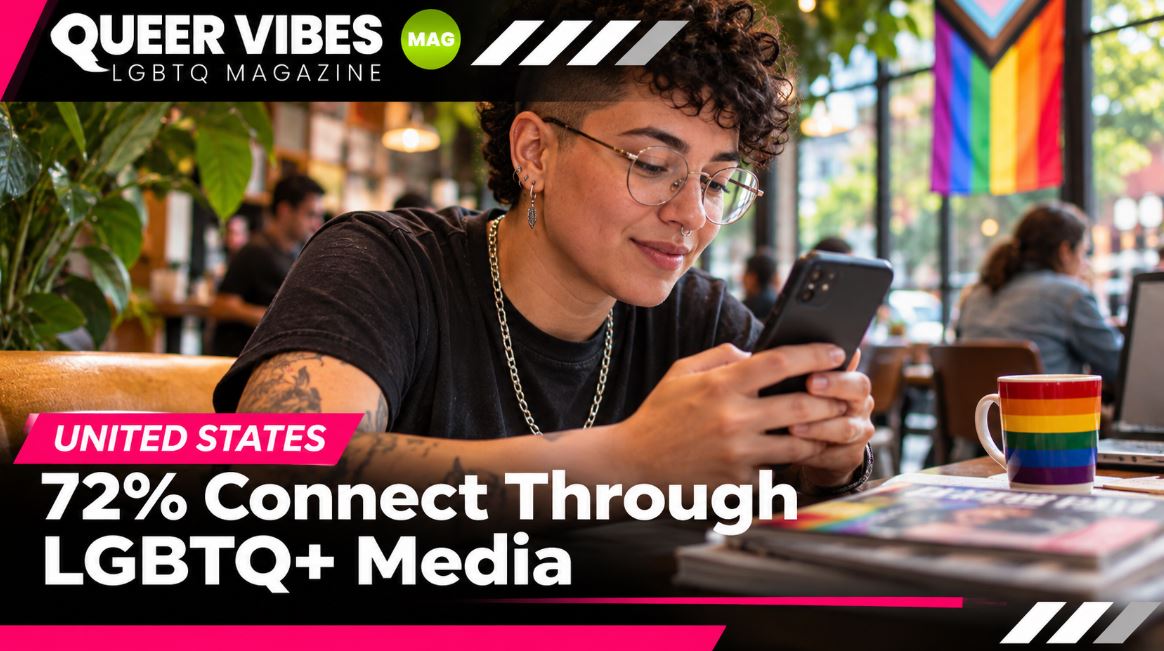
LGBTQ+ news and media remain one of the most widely reported ways queer Americans connect with their communities, according to new findings from the Human Rights Campaign Foundation.
In the organisation’s 2026 Annual LGBTQ+ Community Survey, 72% of respondents identified LGBTQ+ media and news as a way they engage with the LGBTQ+ community.
The findings have drawn renewed attention from independent queer publishers, several of whom discussed the importance of community journalism in a November 8 report by the LGBTQ media trade publication Press Pass Q.
The figures arrive alongside separate research showing that LGBTQ+ adults are particularly likely to participate in online communities, while many specialised news outlets continue to face financial pressure.
Together, these developments raise an important question for LGBTQ+ journalism: if community media remain such a significant point of connection, what will it take to sustain the organisations producing that coverage?
LGBTQ+ media ranks ahead of community venues and events
The Human Rights Campaign Foundation released its latest findings ahead of National Coming Out Day on October 11.
The research examined how LGBTQ+ adults experience visibility, social acceptance and connections with other members of the community.
Among the different forms of community engagement measured, LGBTQ+ media and news emerged as the most frequently selected option.
Some of the findings were particularly revealing:
- 72% identified LGBTQ+ media and news as a way of engaging with the community.
- 55% reported visiting LGBTQ+ spaces such as bars, cafés, bookstores or community centres.
- 49% reported attending Pride or another major community event.
- 65% said they felt very or somewhat connected to the LGBTQ+ community.
These categories describe different forms of participation. Respondents could engage with their communities in multiple ways, so the percentages should not be added together or treated as competing audience shares.
The figures also do not mean that 72% of LGBTQ+ Americans regularly read a particular newspaper or subscribe to a specialist magazine.
Rather, the result identifies community-oriented media and news as a form of connection reported by a large proportion of the survey’s participants.
That distinction matters when interpreting what the research says about the relationship between information and belonging.
A person may encounter LGBTQ+ journalism through a dedicated news website, a community publication, a newsletter, a video or an article shared on social media.
The survey does not establish how frequently respondents use these sources or whether they consider every publication equally trustworthy.
It does, however, indicate that access to LGBTQ+ stories and information forms an important part of how many respondents participate in community life.
Independent queer publishers see a wider role for local journalism
The findings prompted reactions from journalists and media executives working across the United States.
In a November 8 article for Press Pass Q, journalist Joe Siegel gathered responses from editors and publishers including Michael Yamashita of the Bay Area Reporter, Ken Schneck of The Buckeye Flame, Mark Segal of Philadelphia Gay News and Leo Cusimano of Dallas Voice.
Their comments emphasised different aspects of the same issue: community media can provide information that readers may not find consistently in larger news organisations.
Schneck described the importance of his publication for LGBTQ+ residents in Ohio, particularly those living in rural areas where opportunities for face-to-face community engagement may be limited.
For those readers, local coverage can offer information about nearby organisations, regional policy decisions and events that national publications are unlikely to follow in detail.
Segal, whose publication has documented Philadelphia’s LGBTQ+ communities for decades, emphasised the role of queer journalism in preserving community history.
Cusimano linked the survey findings to questions about funding and advertising, arguing that publishers need to demonstrate the broader community value of their work.
These assessments were provided to Press Pass Q and should be understood as the perspectives of the publishers interviewed, rather than independent conclusions established by the HRC survey.
Nevertheless, they identify a distinction that is often overlooked when discussing the value of journalism.
The importance of a news outlet cannot always be measured solely through the number of articles it publishes or the traffic generated by individual headlines.
A regional newspaper may also document organisations, businesses, cultural spaces and public decisions that form part of a community’s collective history.
New Pew research reinforces the importance of online communities
A separate study published by the Pew Research Center on November 5 provides additional context.
Pew found that 49% of LGBTQ+ American adults said they belonged to an online community, compared with 35% of adults who did not identify as LGBTQ+.
The research defined online communities broadly, including social media groups, discussion forums, messaging spaces and other environments where people interact around shared interests or experiences.
Among respondents who participated in online communities, LGBTQ+ adults were also more likely than non-LGBTQ+ adults to identify acceptance as a reason for visiting the online community where they spent the most time.
That response was selected by 73% of LGBTQ+ online-community participants, compared with 51% of their non-LGBTQ+ counterparts.
The study also found that 87% of LGBTQ+ online-community participants identified staying informed as a reason for using their most-visited community, almost identical to the 86% reported by non-LGBTQ+ participants.
These findings do not specifically measure readership of LGBTQ+ news organisations.
Nor can they be directly combined with the HRC figures: the surveys used different questions, samples and methodologies.
Their relevance lies in the broader picture they provide.
For some LGBTQ+ adults, digital spaces are not simply an alternative to physical meeting places. They can be environments for finding information, discussing shared experiences and interacting with people who understand particular challenges.
Journalism and online community participation are different activities, but reliable reporting can form part of the information exchanged within those networks.
The Pew findings reinforce the importance of examining digital community life without assuming that every online interaction serves the same purpose.
Community connection does not guarantee financial stability
The apparent importance of LGBTQ+ media has not eliminated the financial difficulties confronting specialised publications.
The LGBTQ+ Media Mapping Project, developed through a collaboration involving News Is Out, the Local Media Foundation, the MacArthur Foundation and the Craig Newmark Graduate School of Journalism at CUNY, documented serious challenges facing independent queer newsrooms.
Its findings, published in 2025, identified organisations ranging from small, individual-led projects to established multimedia publishers.
Many reported difficulties securing advertising revenue, sponsorships and substantial foundation support.
The project also highlighted the uneven geographical distribution of local LGBTQ+ news coverage.
Those challenges help explain why community fundraising has become part of the conversation about the industry’s future.
On October 8, 2026, the News Is Out collective organised another Local LGBTQ+ Media Giving Day, bringing together newsrooms across the United States.
A subsequent industry update published by Press Pass Q reported that the campaign raised more than $12,000, including individual donations and matching contributions.
According to that report, the money was to be distributed among 18 participating LGBTQ+ media organisations.
The participating publications included the Bay Area Reporter, The Buckeye Flame, Dallas Voice, Philadelphia Gay News, Washington Blade, Seattle Gay News and several other regional and specialist outlets.
The fundraising result demonstrates an effort to develop collective financial support for community journalism.
However, a successful donation campaign should not be confused with evidence that the participating publications have secured stable long-term funding.
The financial needs of a newsroom depend on staffing, production costs, distribution, technology and the amount of reporting it undertakes.
Even outlets with dedicated audiences can struggle to maintain those operations.
What the HRC survey can and cannot prove
The HRC findings provide valuable information, but their methodology is essential to interpreting the results.
The organisation conducted its 2026 Annual LGBTQ+ Community Survey online between August 5 and September 8, 2026.
The final analysis included 9,328 LGBTQ+ adults aged 18 or older living in the United States.
Respondents were recruited primarily through the HRC Foundation’s Community Insights Research Panel and additional distribution channels.
The survey used a nonprobability sampling method.
Researchers applied statistical weights to better align the sample with estimated characteristics of the LGBTQ+ adult population, including age, region, race and ethnicity, sexual identity and gender identity.
Nevertheless, the study was not a conventional random probability sample.
Its results should therefore be interpreted as weighted descriptive estimates rather than exact measurements of every LGBTQ+ adult in the United States.
The survey also does not show whether reliance on LGBTQ+ media has increased or decreased compared with previous years.
A single measurement cannot establish a historical trend without comparable data collected under sufficiently similar conditions.
Likewise, the finding that 72% selected LGBTQ+ media or news as a form of community engagement does not establish that every respondent regularly consumes independent journalism.
Some may use social media accounts, entertainment publications or other forms of LGBTQ+ information.
The distinction between media engagement, trust, frequency of use and financial support remains important.
The challenge for queer media is turning community relevance into continuity
The November discussions among LGBTQ+ publishers illustrate how audience research can inform a wider conversation about the future of community journalism.
The HRC survey suggests that LGBTQ+ media and news play a prominent role in how respondents stay engaged with their communities.
Pew’s separate research shows that LGBTQ+ adults participate in online communities at higher rates than other American adults.
Meanwhile, industry research documents funding pressures and geographical gaps affecting independent LGBTQ+ reporting.
These findings do not, by themselves, establish which editorial formats or business models will succeed.
They do point to a central challenge.
A publication can be meaningful to its readers without generating enough revenue to sustain a professional reporting operation.
For local newsrooms, that challenge is particularly consequential because their coverage often involves events and institutions unlikely to receive sustained national attention.
The next question is not simply whether LGBTQ+ audiences value community media.
It is how publishers, readers, advertisers and funding organisations can support reporting that remains accurate, independent and available over time.
The findings of the 2026 HRC LGBTQ+ Community Survey and Pew Research Center’s November analysis provide new evidence for examining that question.

 English
 Español
Leave a Reply