


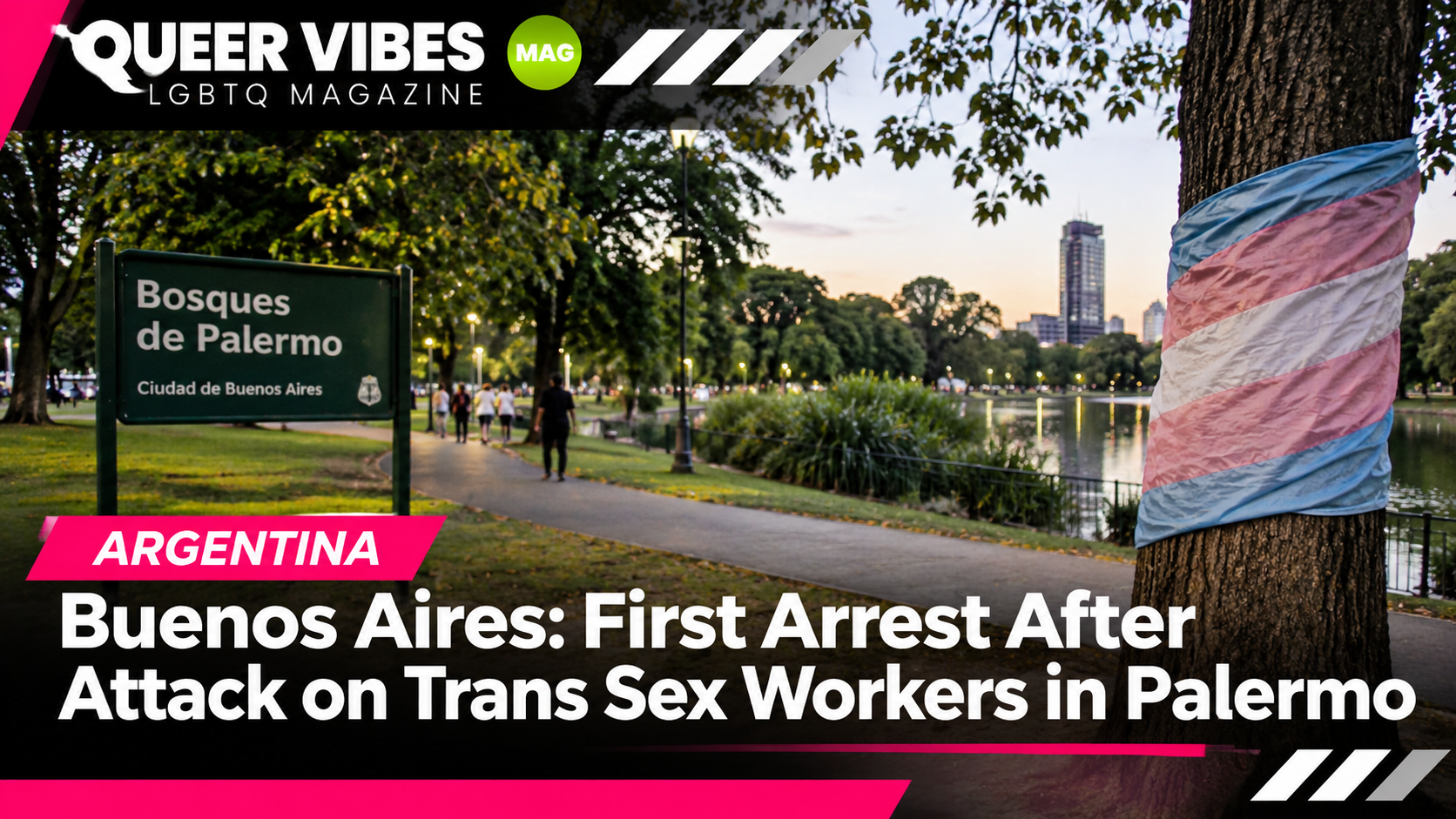
Police in Buenos Aires have arrested a first suspect in connection with a group attack on transgender sex workers in the city’s Palermo district, following an investigation that used social media footage, surveillance cameras and digital records to identify possible participants.
The arrest took place on November 11, 2026, more than a week after the women were assaulted in the Bosques de Palermo, a large park area in Argentina’s capital.
Prosecutors are investigating the incident as alleged bodily injuries aggravated by hatred based on gender identity. The investigation remains open, with additional arrest warrants outstanding.
The case has drawn national attention not only because of the violence recorded in videos circulated online, but also because survivors and transgender rights organisations say the attack reflects a wider problem of harassment and insecurity faced by trans sex workers in Buenos Aires.
One suspect arrested as investigators trace seven profiles
The investigation is being led by Prosecutor Andrea Scanga, who heads Buenos Aires City’s Criminal, Contraventional and Misdemeanour Prosecutor’s Office No. 13, a unit specialising in discrimination cases.
The prosecution opened an investigation after videos of the attack and reports about the incident began circulating publicly.
Investigators subsequently examined footage posted on social media and identified accounts potentially connected to the incident.
The inquiry also involved reviewing security-camera recordings, examining material provided by the city police and requesting information from telephone companies, digital platforms and payment services.
Authorities identified seven profiles of interest, including two associated with minors. Investigators also established seven addresses in different parts of Buenos Aires Province.
Those findings led prosecutors to request searches and arrest warrants.
The procedures were authorised by Judge María Mercedes Maiorano of Buenos Aires City’s Criminal, Juvenile Criminal, Contraventional and Misdemeanour Court No. 2.
Officers arrested one suspect and seized electronic devices for further forensic examination.
According to information released through the prosecution and reported by Argentine news outlets, other arrest warrants remained active after the first detention.
The identification of seven profiles does not mean that seven people have been charged or found responsible. Investigators must still establish the role, if any, of each person identified.
Nor does the arrest establish the detained suspect’s guilt. Criminal responsibility remains a matter for the judicial process.
How the attack unfolded in the Bosques de Palermo
The violence occurred during the first weekend of November, in the area around Avenida de los Ombúes and Andrés Bello, near the Lago de Regatas.
The precise date has been reported inconsistently by Argentine news organisations, with accounts placing the incident in the early hours of November 1 or November 2.
The incident involved a group of young people, many travelling by bicycle, confronting transgender women who were working in the park.
Witness accounts describe verbal abuse followed by physical violence involving sticks, stones and other objects.
Videos subsequently shared on social media showed parts of the confrontation and included messages containing anti-trans slurs.
The footage quickly prompted public condemnation and became an important source of evidence for investigators.
In an account published by Agencia Presentes, a transgender woman who witnessed the incident described seeing the women surrounded by a large group and seeking shelter when she realised the situation was becoming dangerous.
The account also raised questions about the number of participants and whether some of those involved had separated from a larger night-time cycling gathering.
These details remain relevant to the investigation because identifying who participated in the violence is different from establishing how many people were present in the area.
The women targeted in the attack were not simply caught in an unrelated public disturbance. Testimony and videos documenting gender-based insults are among the reasons prosecutors are examining whether discriminatory hatred aggravated the alleged offences.
What is known about the injured women
Early reports from Buenos Aires City’s Ombudsman’s Office indicated that at least six transgender women had been injured.
María Rachid, who heads the office’s anti-discrimination institute, told Agencia Presentes that one woman’s ear had been particularly badly affected, although her injuries were not believed to be life-threatening.
Later, five women underwent medical-legal examinations as part of the prosecution’s investigation.
Those examinations recorded injuries classified as minor under the relevant legal assessment.
The distinction matters: the early accounts concerned the number of women reported injured, while the later forensic findings concerned five people examined during the judicial process.
The available information does not establish that every person affected underwent the same examination or experienced identical injuries.
Beyond the physical consequences, the attack has raised questions about whether the women can safely return to their workplaces.
Several survivors and community representatives have said the violence was not an isolated experience.
They describe repeated harassment and threats affecting transgender sex workers in the Palermo area.
Survivors demand protection, not only arrests
In the days after the attack, transgender sex workers and community organisations gathered outside the Buenos Aires City Legislature to demand action.
The November 5 demonstration brought together survivors, labour organisers, LGBTQ+ advocates and supporters.
Participants called for stronger safeguards against violence and for authorities to address the insecurity faced by people working in the city’s public spaces.
Georgina Orellano, secretary general of the Argentine sex workers’ organisation AMMAR, argued that condemnation alone would not adequately protect those affected.
Her organisation has repeatedly raised concerns about violence, police harassment and the limited practical protections available to sex workers.
At the demonstration, participants also connected their demands to wider questions about employment rights and access to public institutions.
Trans sex workers described the risks involved in returning to the same places where attacks had occurred.
Their concerns go beyond whether the individuals responsible for this particular incident are eventually prosecuted.
They include whether public authorities can provide effective protection against future assaults and respond appropriately when violence is reported.
As documented in Agencia Presentes’ coverage of the protest, the women asked legislators for concrete guarantees of safety rather than a statement of condemnation alone.
Human Rights Watch calls for scrutiny of the police response
International human rights organisation Human Rights Watch has also raised concerns about the attack and the response of local authorities.
In a statement published on November 12, the organisation urged investigators to examine both the violence itself and allegations concerning the police response.
Survivors reported that officers took approximately 20 to 30 minutes to arrive despite emergency calls.
That delay is an allegation requiring examination, rather than an independently established finding about police conduct.
Human Rights Watch also highlighted the legal and social conditions facing sex workers in Argentina.
Consensual sex work between adults is not itself a criminal offence under Argentine national law.
However, Buenos Aires City applies administrative restrictions to the offering of sexual services in certain public spaces.
According to the organisation, the enforcement of such restrictions can expose sex workers to additional discrimination and insecurity.
This broader context is relevant to the Palermo case because the women affected have raised concerns about harassment from multiple sources, including groups of young people and police officers.
Human Rights Watch has called for a thorough investigation into possible anti-trans bias and for survivors to be able to participate safely in the legal process.
Its November 12 statement also situates the incident within the continuing discrimination faced by transgender people in Argentina.
Why the hate-motivated injury investigation matters
The case is being examined under a legal classification involving bodily injuries aggravated by hatred based on gender identity.
That classification reflects the possibility that the victims were targeted because they are transgender.
It does not mean a court has already determined the motive or established the criminal responsibility of the people under investigation.
Prosecutors must assess the available evidence, including witness statements, medical examinations, recordings and communications connected to the incident.
The videos are particularly significant because some were reportedly shared by accounts associated with people suspected of participating in the aggression.
Investigators have used those recordings alongside other information to identify possible suspects.
However, appearing in a video, sharing footage or belonging to a cycling group does not automatically establish that a person committed an offence.
The judicial process must determine individual actions and responsibility.
The investigation may also need to address separate accounts of injuries sustained during the confrontation, without treating those claims as justification for violence against the women.
The next steps in the Palermo investigation
The first arrest marks an important development in a case that initially prompted concerns about whether those involved could be identified.
By November 11, the investigation had progressed from gathering witness accounts and examining viral footage to identifying profiles, conducting searches and detaining a suspect.
But several questions remain unresolved.
Authorities have not yet publicly established the individual responsibility of everyone suspected of participating in the attack.
Additional warrants were still outstanding in the latest confirmed judicial reporting, and seized electronic devices remain subject to examination.
For the women who survived the violence, the case also raises a broader question about protection.
An arrest may advance a criminal investigation, but it does not, by itself, resolve the risks that survivors say they encounter while working in Palermo.
The coming stages of the judicial process will determine whether further suspects are detained and whether the available evidence supports criminal charges related to discriminatory violence.
Meanwhile, the demands made by trans sex workers and human rights organisations place continuing attention on how Buenos Aires authorities respond to threats, harassment and emergency calls in the area.




 English
 Español
Leave a Reply