


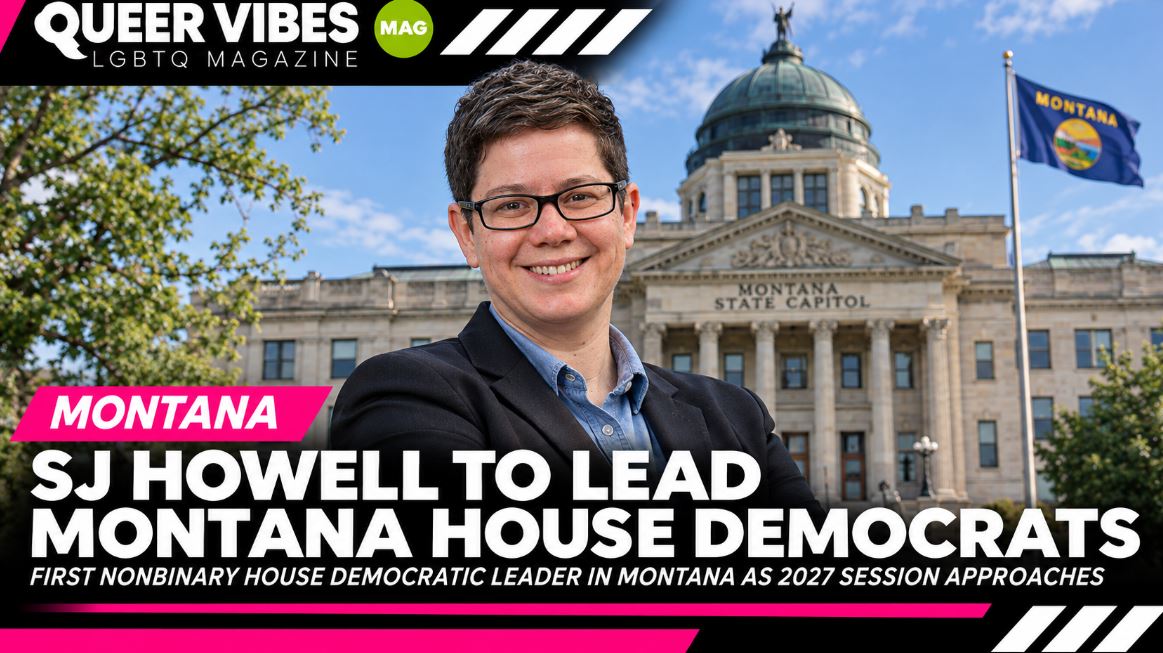
Montana Democrats have chosen transgender and nonbinary lawmaker SJ Howell to lead their minority caucus in the state House of Representatives, while fellow Missoula representative Zooey Zephyr has secured a leadership position of her own.
The November 11, 2026 selections place two LGBTQ+ lawmakers in prominent roles ahead of a legislative session in which Republicans will continue to control the chamber.
For Zephyr, the appointment carries particular historical significance. In 2023, Republican lawmakers voted to bar her from participating in House floor proceedings in person following a dispute over legislation restricting gender-affirming healthcare for minors.
Three years later, Zephyr will help coordinate the Democratic caucus, while Howell will lead its 44 members.
The leadership changes do not transfer control of the House to Democrats. They do, however, give the two lawmakers greater responsibility for shaping the minority party’s legislative response.
A historic leadership appointment in a Republican-controlled House
Howell, who represents House District 100 in Missoula, was elected minority leader without opposition during the Democratic caucus’s November 11 meeting in Helena.
Howell became Montana’s first openly nonbinary legislator following the 2022 election and has served in the House since 2023.
Zephyr, who became the state’s first openly transgender lawmaker in the same election cycle, welcomed Howell’s appointment as a historic first for transgender and nonbinary political leadership in the United States.
Associated Press reported Zephyr’s description of Howell as the country’s first trans or nonbinary legislative party leader. The claim reflects Zephyr’s assessment, although a comprehensive historical survey of every state legislative leadership position has not been independently established.
The development also has a more immediate institutional meaning.
As minority leader, Howell will coordinate the Democratic House caucus, help establish its legislative priorities and represent the group in negotiations with Republican leaders.
Zephyr was selected as one of four Democratic minority whips, alongside Tom France, Shelly Fyant and Josh Seckinger.
Whips help organise communication between lawmakers, monitor support for legislation and coordinate members ahead of votes.
La identidad Montana Democratic Party’s official leadership directory confirms the new appointments.
Three years after Zooey Zephyr was excluded from the House floor
The leadership announcement draws attention to a confrontation that brought Montana’s Legislature into the national spotlight in April 2023.
During debate over restrictions on gender-affirming healthcare for transgender minors, Zephyr warned colleagues about the consequences of supporting the legislation.
Republican House leaders subsequently demanded an apology. Zephyr refused.
Following demonstrations at the state Capitol, the Republican-controlled chamber voted to bar her from participating in proceedings on the House floor for the remainder of the session.
Zephyr was not removed from elected office. She retained the ability to vote remotely, but her exclusion from the chamber limited her participation in legislative proceedings.
Howell was already serving in the House at the time.
During the dispute, Howell opposed the decision to exclude Zephyr and continued participating in the Legislature’s work.
In a May 2023 interview with the Daily Montanan, Howell discussed the responsibilities of representing constituents at a time when another elected member had been restricted from participating on the floor.
The events of 2023 and the appointments of 2026 illustrate a change in the lawmakers’ institutional positions.
Zephyr is moving from a period of direct confrontation with House leadership to a formal role within her party’s leadership team.
Howell, meanwhile, will be responsible for coordinating a broader caucus that includes lawmakers with different constituencies and legislative priorities.
Neither development means that the disputes surrounding transgender rights in Montana have been resolved.
SJ Howell’s political work extends beyond LGBTQ+ legislation
Before entering the Legislature, Howell worked for years in community organising and public policy advocacy.
Their experience includes leadership at Montana Women Vote, a nonprofit organisation engaged in economic justice, civic participation and issues affecting women, LGBTQ+ people and other communities.
Howell has consistently connected social policy to questions about household finances and access to public services.
En un 2024 candidate questionnaire published by Montana Free Press, Howell identified affordable housing, public education funding, Medicaid expansion and property tax relief as major legislative priorities.
Their proposals included stronger protections for renters and support for households facing financial difficulties.
Those earlier positions provide useful background to the priorities outlined following the November 2026 leadership selection.
Both Howell and newly elected Senate Democratic minority leader Laura Smith have identified affordability as a central issue for the 2027 session.
For Howell, that means leading a caucus whose agenda cannot be reduced to legislation concerning gender identity or sexual orientation.
The responsibility will involve debates about taxation, state spending, housing, healthcare and public education, alongside measures affecting civil rights.
Democrats hold 44 seats. Republicans still control the chamber
The November 3 midterm elections changed the balance of the Montana House, but not which party holds the majority.
Democrats gained two seats, increasing their representation from 42 to 44 in the 100-member chamber.
Republicans retain 56 seats.
That arithmetic places clear limits on what Howell and the Democratic leadership team can achieve without additional support.
The caucus can introduce legislation, propose amendments and challenge Republican proposals. Passing contested measures, however, will generally require cooperation from members of the majority.
During the November 11 leadership elections, Republicans also selected Katie Zolnikov of Billings as their candidate for House speaker.
Zolnikov would become the first woman to hold the position in Montana history. The chamber must formally vote on the speakership when the Legislature convenes.
Republicans also chose Tom Millett as majority leader and Mike Vinton as speaker pro tempore.
The distinction between these positions matters.
Zolnikov is expected to preside over the entire House if formally elected speaker, while Howell will lead the Democratic minority rather than the chamber itself.
Both parties have identified affordability as a priority, but their approaches to taxation, government spending and public policy may differ.
That creates opportunities for negotiations without guaranteeing agreement.
The challenge: negotiating legislation while maintaining an opposition
Howell’s new responsibilities also reflect the practical challenges of leading a minority party.
Montana Democrats must decide when to seek compromises with Republicans and when to oppose legislation they believe conflicts with their priorities.
Speaking at the November 11 caucus meeting, Howell acknowledged that balancing cooperation and opposition would be a continuing responsibility.
Previous legislative sessions have shown that disagreements within the Republican majority can sometimes create opportunities for cross-party agreements.
Such outcomes remain dependent on the particular proposals and lawmakers involved.
The 44-member Democratic caucus cannot assume that Republican divisions will provide the votes needed for its agenda.
Howell will therefore have to manage competing demands: maintaining cooperation among Democratic representatives, negotiating with majority leaders and responding to the political priorities of constituents across the state.
Zephyr and the other minority whips will contribute to that coordination.
Their responsibilities extend beyond symbolic representation to the everyday organisation of legislative work.
What could change for transgender rights in Montana ?
The presence of Howell and Zephyr in Democratic leadership is significant for LGBTQ+ political representation.
Both lawmakers have participated in debates over legislation affecting transgender residents, including restrictions on gender-affirming healthcare and questions concerning legal recognition and access to public facilities.
Their new positions may give them additional opportunities to coordinate Democratic responses to future proposals.
However, leadership appointments do not themselves change any existing law.
Republicans retain a majority and can continue advancing their own legislative priorities, subject to legislative procedures, constitutional requirements and judicial decisions.
No specific transgender rights reform was enacted as a consequence of the November 11 caucus elections.
The practical consequences will depend on which bills are introduced in 2027, how the parties respond and whether lawmakers can secure sufficient votes.
The appointments also highlight a broader distinction in LGBTQ+ political representation.
Winning a legislative seat gives an elected official the ability to participate in lawmaking. Holding a caucus leadership position adds responsibility for organising other representatives and influencing a party’s strategy.
How much that translates into legislative results remains to be seen.
January 4, 2027: the next test for Montana’s new leaders
Montana’s next regular legislative session is scheduled to begin in Helena on January 4, 2027.
By then, Howell and Zephyr will be preparing for responsibilities that extend across the Democratic caucus rather than their individual districts.
The opening weeks will provide the first indication of how the new leadership intends to manage negotiations, legislative priorities and disputes with the Republican majority.
The November 11 elections mark a significant moment in the political careers of both lawmakers.
Their longer-term importance will depend less on the appointments themselves than on what happens when the new Legislature begins debating and voting on policy.





 Español
 English
Deja una respuesta