


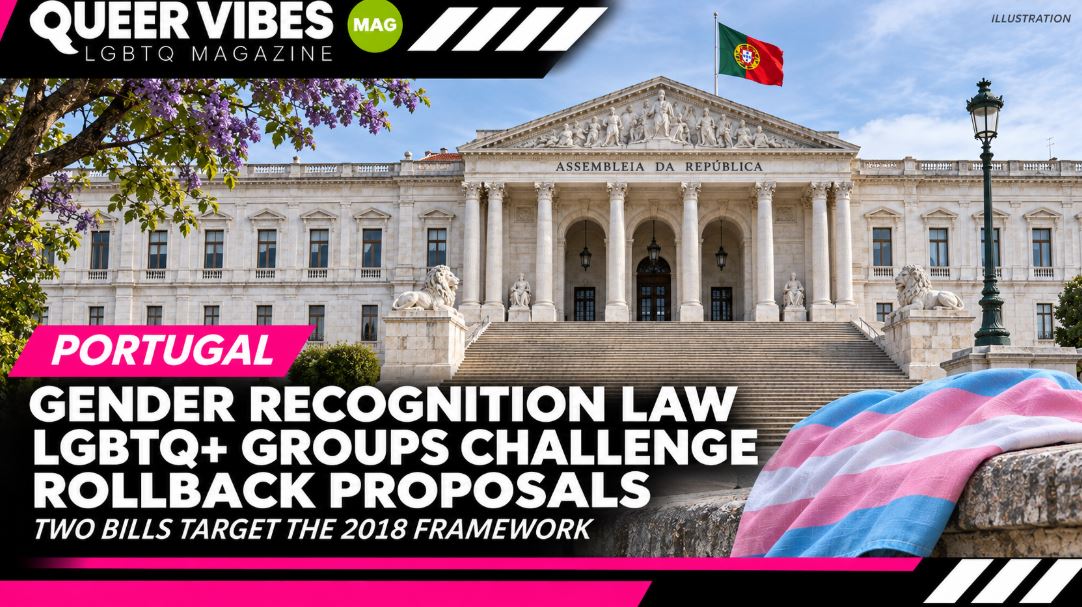
Four European LGBTQ+ organisations have urged Portugal’s parliament to reject two bills that they say would reverse the country’s approach to legal gender recognition.
In a statement published on November 19, TGEU, IGLYO, OII Europe and ILGA-Europe challenged proposals submitted by Chega and the Social Democratic Party, or PSD. Their intervention concerns changes to the legal framework established in 2018, including access to recognition for young people and protections for intersex children.
What Portugal’s 2018 law provides
Law 38/2018, published on August 7, 2018, established rights concerning gender identity, gender expression and sex characteristics.
Its civil-registration procedure allows eligible Portuguese adults to request a change to their recorded sex and first name.
People aged 16 and 17 can also apply through their legal representatives, subject to additional safeguards. These include a personal hearing and a report assessing their capacity to decide and give informed consent. The law specifies that this report must not contain a gender-identity diagnosis.
That distinction separates an assessment of a young person’s decision-making capacity from a medical diagnosis used to validate their identity.
The proposals have already been examined in parliament
The disputed initiatives are Bill 391/XVII/1, submitted by Chega, and Bill 486/XVII/1, submitted by the PSD.
The parliamentary record documents a public hearing on September 25, 2026, covering both proposals alongside a separate CDS-PP initiative concerning healthcare for under-18s.
Portuguese organisations including rede ex aequo, AMPLOS, Casa Qui and ILGA Portugal participated, together with European organisations working on trans, intersex and young people’s rights.
The November statement therefore represents a further intervention in an existing parliamentary process, rather than the announcement of two newly introduced bills. The hearing record identifies the proposals and participating organisations.
Organisations warn of renewed medical barriers
In their joint statement, the four organisations argue that the proposals would restore medical gatekeeping and exclude 16- and 17-year-olds from legal gender recognition.
They also warn of weaker protections against unnecessary interventions on intersex children. These are the organisations’ assessments of the proposed changes, rather than findings issued by a court.
Their request is for parliament to withdraw or reject both bills. If reforms proceed, they call for consultation with trans and intersex people and an assessment of the impact on children’s rights.
The distinction between legislative proposals and an enacted change remains essential: the November 19 statement is an appeal to lawmakers, not notice that the 2018 framework has already been repealed.



 Español
 English
Deja una respuesta