


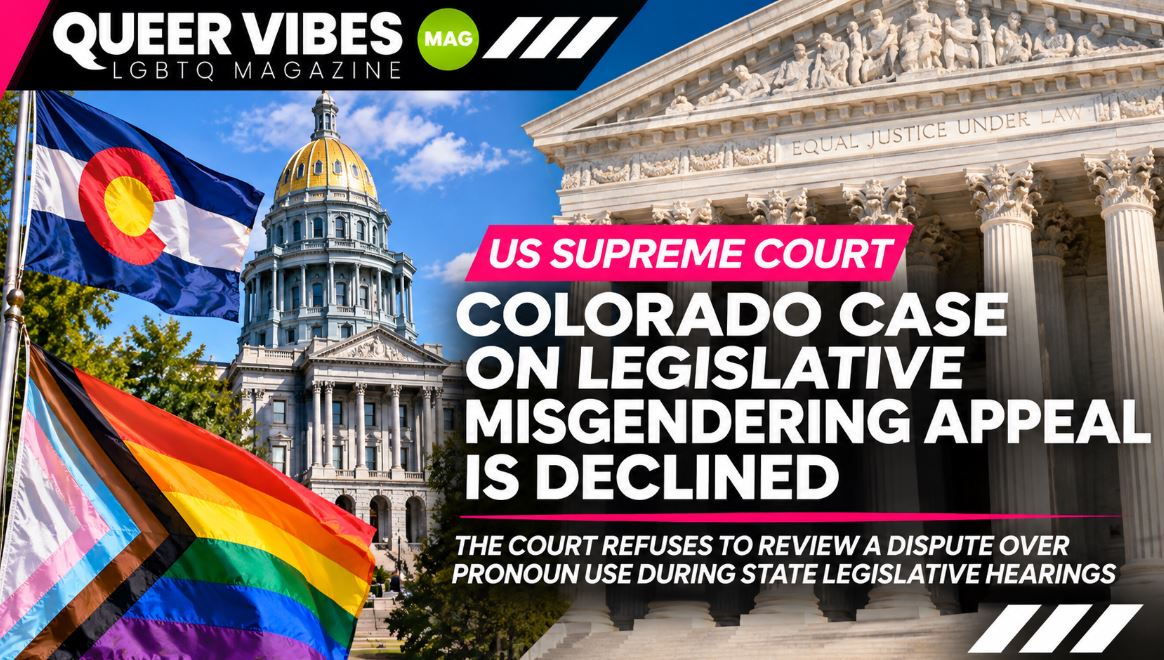
The US Supreme Court has declined to review a lawsuit challenging how Colorado lawmakers handled public testimony involving a transgender woman. The November 16, 2026, decision leaves a federal appeals court ruling intact, protecting legislators from the lawsuit under legislative immunity. It does not, however, establish whether deliberately misgendering someone during a legislative hearing is protected by the First Amendment.
The case, Gays Against Groomers v. Garcia, arose from a dispute over testimony presented during hearings at the Colorado General Assembly in 2024.
Two conservative organisations, Gays Against Groomers and the Rocky Mountain Women’s Network, challenged state lawmakers after participants were interrupted while using names or pronouns that did not reflect a transgender woman’s identity.
The plaintiffs argued that the restrictions amounted to unconstitutional censorship of political speech.
The Supreme Court declined their request for review without issuing an explanation, according to its official docket, case number 26-120.
The decision closes this stage of the litigation while leaving important constitutional questions unanswered.
A dispute that began with a transgender name-change law
The confrontation originated during debates over Colorado House Bill 24-1071, legislation concerning legal name changes for people previously convicted of felonies.
Before the reform, individuals with felony convictions seeking to change their names had to demonstrate sufficient legal justification, known as “good cause.”
The legislation clarified that changing a name to reflect a person’s gender identity could satisfy that requirement.
The bill became widely known as Tiara’s Law, a reference to Tiara Latrice Kelley, a transgender woman from Colorado Springs whose experiences had highlighted the practical difficulties associated with identity documents.
Kelley was also connected to Club Q, the LGBTQ+ nightclub targeted in the deadly November 2022 mass shooting.
Her difficulties obtaining identity documents matching her name had raised wider questions about access to services and support for transgender people with previous convictions.
Colorado Governor Jared Polis signed HB24-1071 into law on April 19, 2024.
However, the legislative debates that preceded its adoption became the starting point for a separate legal dispute about public testimony and freedom of expression.
What happened during the Colorado hearings?
Two participants, Rich Guggenheim of Gays Against Groomers and Christina Goeke of the Rocky Mountain Women’s Network, opposed the proposed legislation.
According to the subsequent federal appeals court ruling, tensions emerged during a January 30, 2024, hearing before the Colorado House Judiciary Committee.
Lawmakers had asked participants to maintain respectful language and avoid misgendering or deadnaming witnesses and other individuals discussed during proceedings.
Goeke continued referring to Kelley using masculine pronouns. After exchanges with lawmakers over the relevance and wording of her comments, the committee ended her testimony and recessed.
Guggenheim had declined to testify under the conditions announced at that hearing.
Further disagreements arose during a Senate Judiciary Committee hearing on March 27.
Goeke again challenged the committee’s restrictions and attempted to use Kelley’s former name and masculine pronouns.
Her testimony was interrupted and subsequently stopped.
Guggenheim also faced interruptions while discussing transgender identities and referring to Kelley.
The plaintiffs additionally alleged that part of Goeke’s testimony had been removed from the official audio recording.
They maintained that lawmakers were suppressing their political viewpoint rather than simply enforcing neutral standards of conduct.
The dispute eventually developed into a federal lawsuit against five Colorado legislators, including Representative Lorena Garcia.
Why the federal appeals court dismissed the challenge
The litigation reached the US Court of Appeals for the Tenth Circuit, which issued its decision on March 10, 2026.
The judges examined whether the lawmakers could be sued over the establishment and enforcement of rules governing legislative hearings.
Their ruling centered on legislative immunity, a legal doctrine that protects lawmakers from certain lawsuits arising from their legislative functions.
The court determined that establishing rules for public hearings, managing testimony and deciding what belongs in the legislative record fall within the sphere of legislative activity.
Consequently, the lawmakers were entitled to immunity from the plaintiffs’ claims.
The appeals court also addressed whether the dispute had become moot because the original legislative proceedings had already ended.
On that question, the judges disagreed with the lower court’s reasoning.
They concluded that the controversy remained active because the plaintiffs intended to participate in future hearings and lawmakers expected to continue enforcing the challenged rules.
Nevertheless, legislative immunity prevented the lawsuit from proceeding against the legislators.
Crucially, the appeals court did not determine whether the restrictions themselves violated the First Amendment.
That distinction is central to understanding what happened when the case subsequently reached the Supreme Court.
What the Supreme Court’s refusal actually means
On November 16, 2026, the Supreme Court denied the petition for review in Gays Against Groomers v. Garcia.
The refusal allows the Tenth Circuit’s ruling to remain in effect.
It does not mean that the Supreme Court has endorsed every restriction imposed during the Colorado hearings.
Nor does it establish a nationwide constitutional rule determining whether the intentional use of incorrect pronouns must be permitted or prohibited during public legislative testimony.
The central legal question resolved by the appeals court concerned the availability of lawsuits against legislators performing protected legislative functions.
The underlying constitutional dispute over speech restrictions was not decided on its merits.
The distinction matters because a refusal to hear a case is different from a Supreme Court judgment directly examining the constitutional arguments.
The decision therefore leaves the lower court’s procedural ruling in place without creating a new Supreme Court precedent specifically addressing misgendering.
Free speech, public participation and respect for transgender people
The controversy illustrates an ongoing tension in US political institutions: how to protect meaningful public participation while maintaining rules intended to prevent harassment or degrading treatment during official proceedings.
Legislative hearings allow residents to challenge proposed laws, question elected representatives and express disagreement with government policies.
At the same time, committees establish procedures governing speaking time, conduct and interactions between participants.
In this case, the plaintiffs argued that the Colorado rules prevented them from expressing their views without adopting terminology they rejected.
The Institute for Free Speech, which represented them, criticised the Supreme Court’s refusal to intervene, arguing that the appeals court’s interpretation of legislative immunity could make it harder to challenge similar restrictions.
For transgender people, deliberate misgendering and deadnaming can also carry significant personal and social consequences, particularly when they occur in official settings where a person’s identity or legal status is being publicly discussed.
The broader debate therefore involves competing questions about freedom of expression, legislative authority and respectful treatment.
But the legal outcome should not be confused with a definitive constitutional answer to those questions.
The November 16 decision leaves Colorado’s legislative immunity ruling standing. The boundaries of First Amendment protections concerning misgendering in public hearings remain unresolved by the Supreme Court.
Primary sources:


 Español
 English
Deja una respuesta