


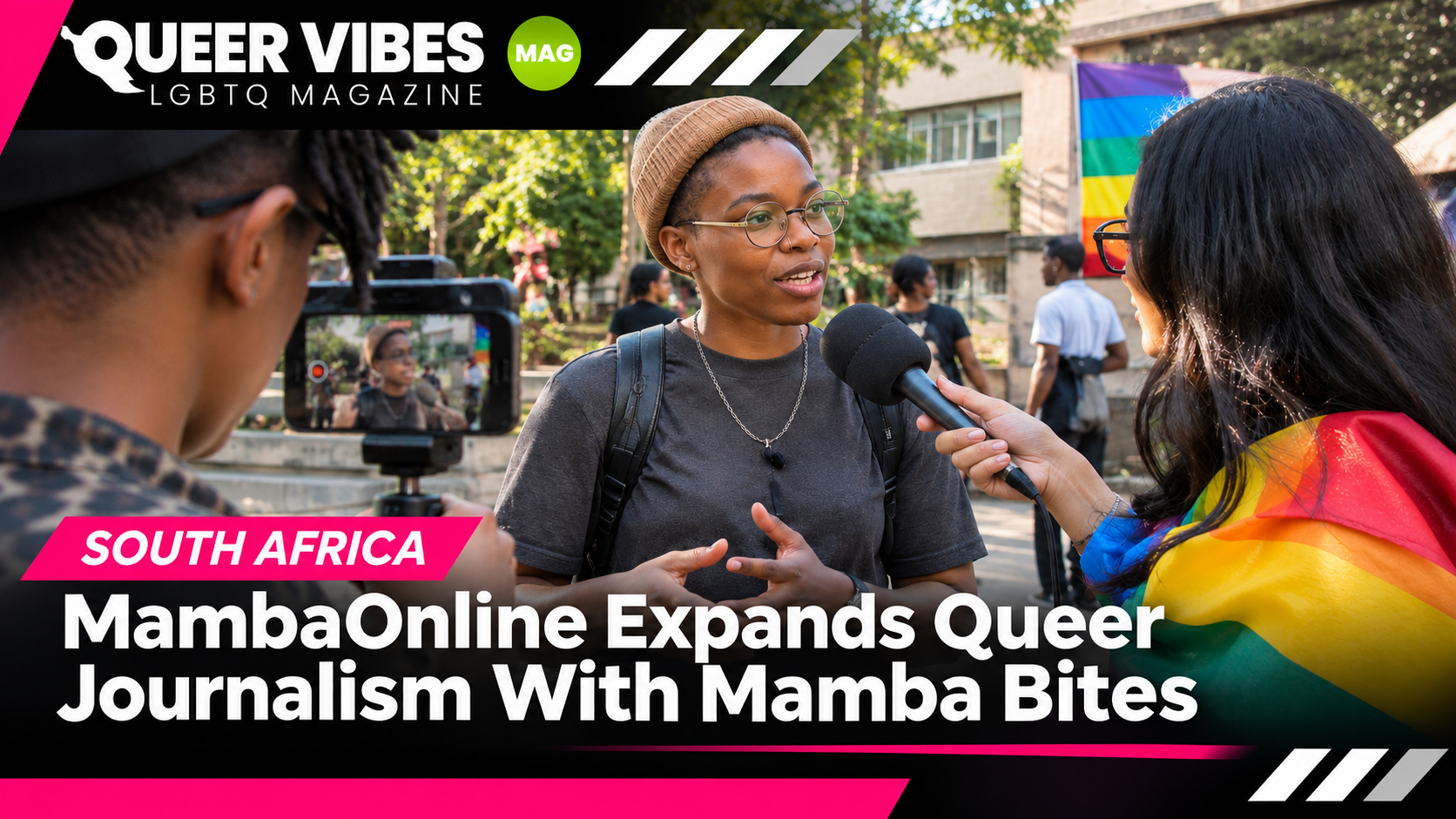
South African LGBTQ+ news outlet MambaOnline is expanding its reporting through Mamba Bites, a weekly mobile journalism programme covering court cases, community concerns, public health and political developments affecting queer people.
Launched on October 27, 2026, the programme is presented by managing editor Nompilo Gwala and brings together reporting from across South Africa in a format designed for digital audiences.
The initiative arrives at a significant moment for the publication. Founded in 2001, MambaOnline is celebrating 25 years of LGBTQ+ journalism while seeking financial support to maintain its independent newsroom.
Three episodes announced between October 27 and November 11 illustrate its developing editorial approach. Meanwhile, a new fundraising event scheduled for November 29 highlights the financial pressures facing a publication that has spent a quarter-century documenting queer life in South Africa.
Mamba Bites brings local LGBTQ+ stories into a weekly news programme
The new programme represents an expansion of MambaOnline’s existing digital reporting rather than a departure from its established coverage.
Its editorial focus remains on the issues that have long shaped the outlet: discrimination, access to justice, LGBTQ+ visibility, public health and community life.
But Mamba Bites presents those subjects through a recurring mobile-first news format, combining reporting with a more immediate form of digital storytelling.
The debut episode, introduced on October 27, illustrates the range of subjects the programme intends to cover.
Its first segment revisited the killing of Kwakhanya Mhlanganisi, a 16-year-old from Khayelitsha who died in December 2025. His mother has continued seeking justice amid repeated delays in the criminal proceedings.
The programme examined how those postponements have affected the family and the community supporting them.
Another segment addressed an Equality Court ruling against Dawood Lagardien, a shop owner in Gqeberha whose treatment of LGBTQ+ customers had become the subject of legal proceedings.
The court ordered Lagardien to apologise and pay R200,000 in damages after finding hate speech, discrimination and harassment.
The episode also explored MambaOnline’s own history through its anniversary exhibition at Constitution Hill in Johannesburg.
These subjects span three distinct forms of reporting: following an unresolved criminal case, explaining the consequences of a discrimination ruling and documenting LGBTQ+ history.
Their inclusion in the same programme demonstrates how the format can connect individual legal developments to the broader experiences of the communities affected.
From delayed court cases to HIV prevention and political participation
The following editions expanded that approach.
On November 2, MambaOnline published another episode focusing on the delayed Johannesburg trial involving seven alleged attackers associated with the so-called Grindr Gang case.
The programme also included LGBTQ+ community perspectives on South Africa’s approaching local elections.
Its third segment examined findings from Outright International’s Killed for Who They Are report, which documented hundreds of targeted killings of LGBTQ+ people across multiple countries.
The report, examined separately in Queer Vibes Mag’s coverage of the 233 documented killings, raises important questions about the identification of hate-motivated violence, the quality of available data and the accountability of authorities.
By including that research alongside a local criminal case, Mamba Bites placed South African experiences within a wider international discussion about violence against LGBTQ+ communities.
The November 11 edition shifted between political visibility, healthcare and community celebration.
It featured Deputy Minister for Women, Youth and Persons with Disabilities Steve Letsike discussing the continuing significance of Pride at Johannesburg Pride.
The programme also addressed the rollout of lenacapavir, a long-acting HIV prevention treatment, and covered Dr Bev Ditsie’s Nostalgia Pride Picnic at Constitution Hill.
That combination is important.
LGBTQ+ journalism is often associated primarily with discrimination, violence and legal disputes. Those subjects remain essential, but they are not the entirety of queer life.
A publication serving a community also has reason to cover healthcare developments, cultural spaces, public celebrations and opportunities for political participation.
The episodes released so far suggest that Mamba Bites is seeking to maintain that breadth while giving audiences a recurring way to follow developments.
A quarter-century of queer reporting becomes a public archive
The launch coincides with MambaOnline’s 25th anniversary, which the publication has marked through exhibitions, community events and a campaign to sustain its future.
In October, MambaOnline partnered with the Thami Dish Foundation to present an anniversary exhibition at Johannesburg’s Constitution Hill.
The historic site, associated with South Africa’s constitutional democracy and the country’s struggles against discrimination, provided a setting for examining how LGBTQ+ lives have been documented over the past 25 years.
The exhibition brought together 25 selections from MambaOnline’s archive, including eight photographs and 17 significant articles.
Rather than presenting the anniversary solely as a celebration of the publication, the exhibition explored the relationship between journalism and collective memory.
Stories about hate crimes, legal reform, Pride celebrations, cultural figures and everyday community experiences become historical records when they are preserved.
For LGBTQ+ communities whose experiences have not always received sustained attention from larger news organisations, maintaining those records can be especially important.
MambaOnline’s archive also illustrates how the same publication can serve different purposes over time.
A report about discrimination may initially help readers understand an immediate controversy. Years later, that reporting can provide evidence of the attitudes, institutions and legal conditions that shaped a particular period.
The exhibition was therefore more than a retrospective of an established website. It demonstrated how accumulated local journalism can contribute to a broader understanding of South African LGBTQ+ history.
Why MambaOnline is raising money to secure its future
The anniversary also brings attention to the difficulty of financing independent LGBTQ+ journalism.
MambaOnline operates in a specialised media market where advertising and other commercial revenue may be insufficient to sustain the reporting its audience needs.
The organisation has been pursuing several forms of financial support.
In July 2026, MambaOnline announced that South Africa’s Media Development and Diversity Agency had been supporting the publication since April.
The agency’s role is to promote media development and diversity, including support for community and smaller media organisations.
That backing is separate from MambaOnline’s Write the Next 25 fundraising campaign, which asks readers, allies and other supporters to contribute to the publication’s continued operation.
The Other Foundation has also committed a matching grant of up to R200,000 to support the campaign.
The grant appears in the foundation’s published funding allocations under the Mamba Online Foundation.
A matching commitment does not mean that the full amount has already been raised or paid. Its purpose is to increase the funding available when qualifying community contributions are received.
On November 13, MambaOnline announced another fundraising event: Sundowners for the Next 25, scheduled for November 29 at Poppy’s in Cresta, Johannesburg.
The event is intended to combine the publication’s anniversary celebrations with an effort to raise money for its journalism.
The timing illustrates the challenge facing the organisation. Even as MambaOnline invests in a new digital programme and celebrates its historical achievements, it must continue securing resources for future reporting.
What mobile journalism can change — and what it cannot
Mobile journalism offers smaller newsrooms ways to produce and distribute stories without relying on the infrastructure associated with traditional television broadcasting.
For an established digital publication, a recurring video programme can also provide another entry point for audiences who may be less likely to encounter a long written report.
But a new format does not eliminate the work behind reliable journalism.
Following a criminal case requires attention to court dates, evidence and the distinction between allegations and findings. Reporting on public health demands accuracy about medical developments. Political coverage needs context that extends beyond a short statement or a single event.
Short-form reporting can introduce these subjects, but its usefulness depends on the quality and continuity of the journalism supporting it.
That is where MambaOnline’s existing reporting experience matters.
The publication is not beginning with a new social media account and an untested editorial identity. It is adapting a body of work developed over 25 years to a different way of delivering news.
There are limits to what can currently be concluded about the programme’s impact.
MambaOnline has not publicly established, through the announcements examined here, how many viewers Mamba Bites has reached, whether it has attracted a substantially new audience or how the format has affected newsroom finances.
Its launch therefore demonstrates an editorial strategy, not yet evidence of measurable audience growth or financial success.
The next chapter for South African queer media
MambaOnline’s anniversary highlights two priorities that are closely connected.
The first is preserving the reporting, photographs and community histories accumulated since 2001.
The second is ensuring that the newsroom can continue producing new work at a time when LGBTQ+ communities still face significant challenges involving discrimination, healthcare, political representation and personal safety.
Mamba Bites addresses the question of how that journalism reaches audiences.
The funding campaign addresses whether the organisation can continue producing it.
Together, they offer a revealing picture of the choices facing independent LGBTQ+ media: adapting to new digital habits while protecting the reporting capacity and editorial continuity that give a publication its value.
The programme’s future will depend not simply on releasing more episodes, but on whether the format helps MambaOnline sustain informed, accountable and accessible coverage of the communities it serves.
Readers can explore the programme through MambaOnline’s original Mamba Bites announcement.

 Español
 English
Deja una respuesta