


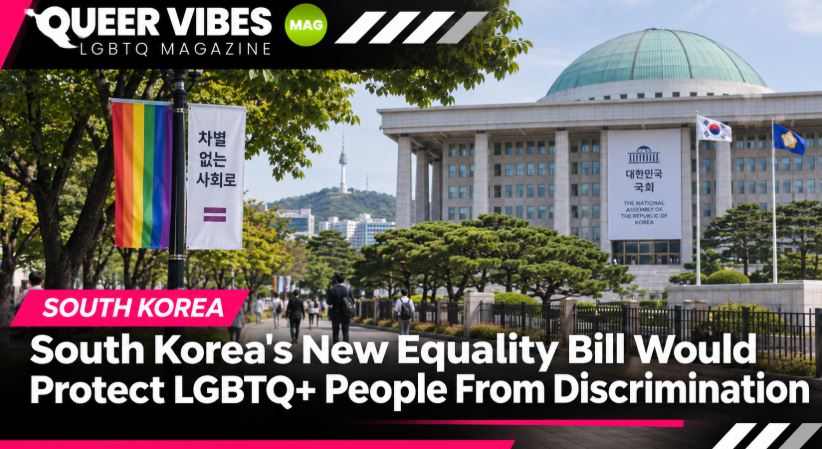
A new bill introduced in South Korea’s National Assembly could establish nationwide protections against discrimination based on sexual orientation and gender identity, as lawmakers revisit an issue that has repeatedly stalled for nearly two decades.
Democratic Party lawmaker Park Ju-min introduced the proposed Equality Act on November 11, 2026, alongside 11 other lawmakers. The bill was referred to the National Assembly’s Legislation and Judiciary Committee the following day.
The proposal would prohibit unjustified discrimination across employment, education, public administration and access to goods and services. It would also introduce procedures allowing people who experience discrimination to seek corrective measures and compensation.
The legislation has not been passed. But its introduction brings the number of comprehensive equality and anti-discrimination bills currently before South Korea’s 22nd National Assembly to three.
For LGBTQ+ people in South Korea, the debate concerns a longstanding gap between constitutional guarantees of equality and the legal mechanisms available when discrimination occurs in everyday life.
What would South Korea’s proposed Equality Act change?
The proposed law is intended to create a comprehensive framework for addressing discrimination across multiple areas of society.
South Korea already has laws dealing with particular forms of unequal treatment, including discrimination related to disability. However, the country has not enacted a general anti-discrimination law covering the full range of personal characteristics and circumstances identified in the new proposal.
Park’s bill lists grounds for protection including sex, disability, age, nationality, ethnicity, religion, political opinion, educational background, employment status, sexual orientation and gender identity.
These protections would apply across four principal areas: employment, access to goods and services, education and vocational training, and the implementation of laws and government policies.
The proposal also recognises different forms of discriminatory treatment.
Direct discrimination would include treating an individual unfavourably without reasonable justification because of a protected characteristic.
The bill would also address indirect discrimination, where an apparently neutral rule places particular people or groups at a disadvantage without sufficient justification.
Harassment, sexual harassment and certain advertisements expressing or encouraging discriminatory treatment are also addressed in its provisions.
Another important element concerns overlapping forms of discrimination.
The bill proposes that cases involving more than one protected characteristic should be assessed together rather than treating each ground in isolation.
For example, a person could experience discrimination connected to both gender identity and employment status. The proposed framework would allow the combined circumstances to be considered when determining whether unlawful discrimination occurred.
These provisions would become legally enforceable only if the legislation passes through the parliamentary process.
What could the bill mean for LGBTQ+ employees and job applicants?
One of the most significant elements of the proposal concerns employment.
Under the bill, an employer would be prohibited from unjustifiably disadvantaging someone because of their sexual orientation, gender identity or another protected characteristic.
The proposed protections would cover decisions about recruitment, working conditions, promotion and other employment matters.
The text also includes a procedure intended to help people obtain information about decisions they believe may have involved discrimination.
A job applicant who suspects discriminatory treatment could request written information about the criteria used to assess candidates and the applicant’s position within the relevant evaluation.
Access to that information could make it easier to understand whether a decision involved legitimate selection criteria or potentially discriminatory treatment.
The proposal also establishes rules governing evidence in discrimination disputes.
A person alleging discrimination would need to establish that discriminatory treatment occurred. The other party would then bear responsibility for demonstrating that the treatment was not discriminatory or had a legitimate justification.
The provision is designed to address the practical difficulty of proving discrimination when employers or institutions hold much of the relevant information.
For LGBTQ+ workers, the potential significance extends beyond recruitment.
A comprehensive law could provide a clearer basis for challenging unequal treatment in workplaces where sexual orientation or gender identity is currently not covered by a specific statutory protection.
However, the precise legal effects would depend on the final wording adopted by lawmakers and how the legislation was subsequently implemented.
How would discrimination complaints be handled?
Park’s proposal places considerable emphasis on correcting discriminatory conduct and providing remedies to affected individuals.
Under its proposed system, people who believe they have experienced discrimination could bring complaints to the National Human Rights Commission of Korea.
The commission would be able to examine complaints and recommend corrective action.
If a party failed to comply with a recommendation without a legitimate reason, the proposal would allow the commission to issue a corrective order.
Continued non-compliance could result in an administrative enforcement payment, with the proposed limit reaching 30 million won.
Courts would also have a role.
The bill provides for civil compensation and would allow courts to order certain temporary measures, including stopping alleged discriminatory conduct while proceedings continue.
These mechanisms distinguish the proposed framework from a law focused primarily on criminal punishment.
They would create several possible routes for addressing discrimination, from institutional recommendations to enforceable orders and civil proceedings.
The distinction is central to how Park has presented the legislation.
Rather than introducing criminal penalties for discriminatory conduct, the proposal seeks to strengthen procedures for correcting violations and obtaining remedies.
Whether those mechanisms would provide sufficient protection is already part of the political and civil society debate.
Why the latest proposal contains no criminal penalties
South Korea’s efforts to introduce comprehensive anti-discrimination legislation date back to 2007.
Since then, successive proposals have encountered political opposition and failed to become law.
Park previously sponsored an equality bill during the 21st National Assembly, but it did not pass before that Assembly’s term ended.
His latest proposal modifies several elements of the earlier approach.
The November 2026 text removes punitive damages and does not include criminal penalties. Administrative fines and corrective measures instead form part of its enforcement framework.
Park has presented those changes as an attempt to make the legislation more acceptable to lawmakers and increase its chances of passage.
The decision also addresses concerns raised by some conservative religious organisations about the potential consequences of anti-discrimination legislation for religious expression.
During his November 11 press conference, Park emphasised that the proposal contained no provision regulating sermons delivered from church pulpits.
Supporters of comprehensive anti-discrimination protections have long argued that the absence of a general law leaves people without consistent remedies across different areas of life.
Opponents, including some conservative Christian organisations, have expressed concerns about religious freedom and freedom of expression, particularly where proposed protections include sexual orientation and gender identity.
Those disagreements have contributed to the repeated failure of earlier bills.
Removing criminal penalties may reduce one point of contention, but it does not establish that sufficient parliamentary support exists for the current proposal.
Three equality bills are now before the National Assembly
The November proposal is not the only legislation currently under consideration.
Two other lawmakers have introduced related measures during the 22nd National Assembly.
Son Sol of the Progressive Party introduced an anti-discrimination bill earlier in 2026, followed by another proposal led by Chung Choon-saeng of the Rebuilding Korea Party.
Park’s Equality Act adds a third legislative proposal.
The introduction of three bills does not mean they have been combined or that lawmakers have reached agreement on a final text.
Each proposal remains subject to parliamentary consideration.
Nevertheless, the existence of multiple bills has prompted renewed pressure on the National Assembly to begin substantive discussions.
On November 12, lawmakers and civil society organisations gathered outside the National Assembly in Seoul to call for legislative action.
Representatives of the Democratic Party, Progressive Party and Rebuilding Korea Party participated alongside the Coalition for Anti-Discrimination Legislation and organisations working on women’s rights, disability rights, migrant rights and LGBTQ+ equality.
The organisations called on the Legislation and Judiciary Committee to begin reviewing the proposals rather than allowing another parliamentary term to pass without comprehensive legislation.
The coalition’s demands also extend to the strength of the proposed enforcement mechanisms.
While campaigners welcomed Park’s bill, some have called for stronger remedies in cases involving particularly serious or malicious discrimination.
The discussion therefore concerns both whether South Korea will enact a general equality law and what protections that law would ultimately provide.
Why LGBTQ+ protections are central to the debate
The inclusion of sexual orientation and gender identity is particularly significant because these categories have repeatedly generated controversy during earlier legislative efforts.
South Korea’s Constitution establishes a general principle of equality before the law.
But constitutional language and protection through specific anti-discrimination procedures are not the same thing.
Without a comprehensive statute, individuals may face different options for seeking remedies depending on the type of discrimination, the institution involved and the legal framework applicable to their circumstances.
The proposed Equality Act aims to provide a more consistent approach across several areas of daily life.
For LGBTQ+ people, that could affect situations involving employment, educational institutions, commercial services and interactions with public authorities.
The bill is not a proposal to legalise same-sex marriage or establish legal recognition for same-sex partnerships.
Its principal purpose is to establish rules against discriminatory treatment and procedures for responding when those rules are breached.
This distinction matters because LGBTQ+ legal equality involves several separate areas of law.
A comprehensive anti-discrimination statute could provide protections without resolving other outstanding questions concerning family recognition or related legal rights.
What happens next?
The Equality Act was filed on November 11 and referred to the Legislation and Judiciary Committee on November 12.
The next substantive step would involve parliamentary examination of the proposal.
Lawmakers could hold hearings, request further analysis, debate the bill’s provisions or consider amendments.
There is currently no confirmed date for a committee hearing on Park’s proposal.
Nor is there evidence that the three equality bills have been consolidated into a single agreed legislative text.
The history of unsuccessful attempts makes the distinction between introducing a bill and enacting a law especially important.
For LGBTQ+ rights organisations, the immediate question is whether the current National Assembly will move beyond the introduction of proposals and begin the legislative work needed to consider them.
The coming stages will also determine whether the framework retains its existing approach to sexual orientation and gender identity, how its remedies are structured and whether political disagreements can be resolved.
Nearly twenty years after South Korea first attempted to introduce comprehensive anti-discrimination legislation, the latest proposal has reopened the debate.
Whether it leads to enforceable protections will depend on what lawmakers do next.
The proposed legislation is recorded as Equality Act Bill No. 2222676. The Coalition for Anti-Discrimination Legislation has also published its position and information about the campaign for parliamentary consideration.




 Español
 English
Deja una respuesta